The Loudest Silence in Africa: Flying Over the Mara and Serengeti safari
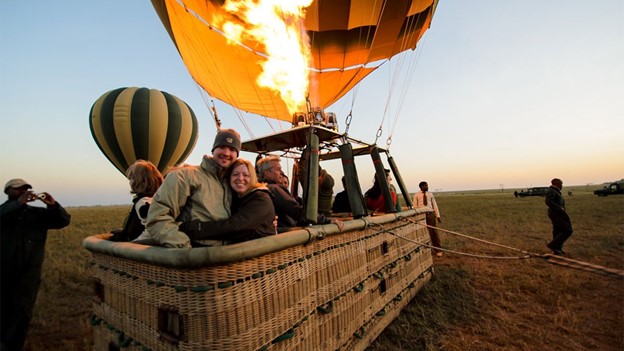
Nobody warns you about the noise. Not during the flight that part actually is silent, or close to it but before it, in the dark, when the burner first fires and a column of flame roars three meters over your head like something out of a blacksmith’s dream. You’re standing in a wicker basket on your side, tipped over in the grass, and the only light for a hundred meters is that orange flare licking into a half-collapsed envelope of nylon. It’s 5:40am. You haven’t had coffee. And you’re about to be lifted off the ground by nothing but hot air and physics that felt more convincing in a classroom than they do right now.
That’s the part nobody puts in the brochure. Everything after the drifting, the wildlife, the champagne is the easy sell. The ignition is the real initiation.
Two Skies, Two Temperaments
Ask ten people whether to fly over the Masai Mara or the Serengeti and you’ll get ten confident, contradictory answers, because the two aren’t really the same experience wearing different scenery.
<cite index=”7-4″>The Mara is compact about 1,510 square kilometers and sits directly in the migration’s path from July through October</cite>, which means the wildlife density per square meter of sky is almost absurd. You’re not searching for animals below; you’re choosing which cluster to look at first. Balloons tend to launch from <cite index=”7-4″>the Mara Triangle or the Talek and Musiara sectors</cite>, and the landscape reads less like “savannah” in the abstract and more like a specific, memorized place: <cite index=”3-2″>riverine forest giving way to open grass, then an escarpment, then a river bending back on itself</cite>.
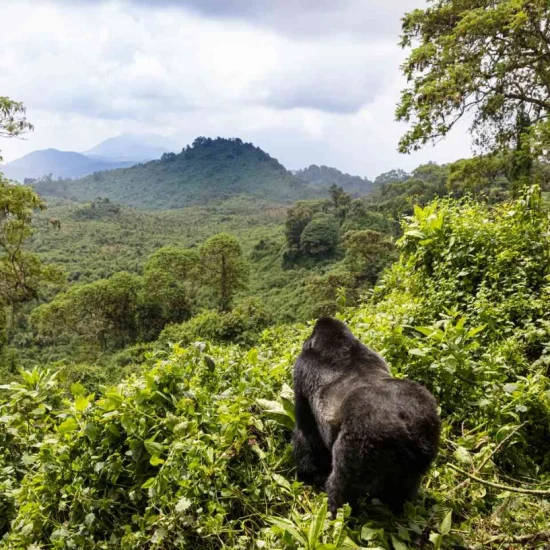
<cite index=”7-3″>The Serengeti, by contrast, is nearly ten times the area roughly 14,750 square kilometers</cite> and flying over it feels less like observing wildlife and more like watching geology happen in real time. This is <cite index=”7-3″>where the migration itself originates, with well over a million wildebeest tracing a slow annual circle across the plains</cite>. Depending on the season you might launch from <cite index=”7-3,7-4″>central Seronera, which runs year-round; Ndutu in the south during calving season; the Western Corridor for the Grumeti crossings; or the far north near Kogatende when the herds are hurling themselves across the Mara River</cite>. It’s the same migration as the Mara’s, just caught at a different chapter.
If the Mara is a crowded, generous dinner party, the Serengeti is standing at the edge of something too large to fully take in. Neither is the “better” choice. They’re just different kinds of overwhelming.
What the Hour Actually Feels Like
Most people expect drama and get something closer to reverence. <cite index=”5-3″>The flight itself runs 60 to 75 minutes</cite>, and for the first ten of them, almost nobody speaks. Not out of instruction out of instinct. The basket creaks. Somewhere below, a jackal trots across open ground, oblivious, because sound doesn’t carry the way it does from a vehicle; there’s no engine to announce you.
Pilots fly the terrain more than the compass, dropping low over a stretch of river <cite index=”5-3″>to bring you close to wildlife, then climbing again for the wider panoramas</cite> a technique that makes the ride feel less like transportation and more like being handed binoculars for the entire landscape at once. You might pass low enough over a hippo pod to hear the grunt before you see the shape, or catch <cite index=”5-3″>a lion pride still shaking off the night</cite> from three hundred feet up, a vantage point that turns even a sleeping cat into something monumental.
Then, without much ceremony, the pilot starts calling out brace positions, and the practical business of landing takes over <cite index=”10-2″>a fully qualified pilot bringing the basket down, sometimes with a bump, sometimes so smoothly you don’t register you’ve stopped moving</cite>.
Breakfast in a Place with No Address
What happens next is the part every operator gets right, because it’s been refined for decades: a table appears where there was none. <cite index=”8-2″>Linen, hot food, and chilled sparkling wine, laid out in the open bush with staff who arrived ahead of you to set it all up</cite>. It’s a strange, almost theatrical contrast white tablecloths in the middle of country that, twenty minutes earlier, belonged entirely to buffalo and vultures but it works precisely because of that contrast. You eat eggs and drink champagne while a pilot recounts the flight, and somewhere behind you, the crew is already packing the envelope back into its bag for tomorrow’s guests.
The Unglamorous Arithmetic
None of this is cheap, and it’s worth understanding why before you balk at the number. <cite index=”2-2″>Each balloon requires a crew of roughly six, a licensed pilot, and another ten people working logistics behind the scenes plus conservation and park fees layered on top</cite>. The balloons themselves aren’t permanent fixtures either: <cite index=”2-2″>a typical envelope is retired after around 850 flight hours</cite>, which is a shorter working life than most people assume for something that costs what a small aircraft costs.
Given that, prices in the <cite index=”5-4″>$450–$650 per person range are fairly standard across Mara operators</cite>, with <cite index=”5-4″>park conservation fees sometimes billed separately</cite> worth confirming before you book, since it can shift the real total noticeably.
Timing It Right
The migration doesn’t hold still, so neither should your calendar:
- July–October — <cite index=”5-5″>peak river-crossing season in the Mara</cite>, and <cite index=”7-4″>the same window for the dramatic Mara River crossings in the Serengeti’s north</cite>. Spectacular, and everyone else knows it too.
- December–March — <cite index=”7-3″>calving season around Ndutu in the southern Serengeti</cite>, and <cite index=”5-5″>strong big-cat viewing in the Mara</cite>, when predators are easiest to spot on short grass.
- May–July — <cite index=”7-3″>the Grumeti River crossings in the Western Corridor</cite>, dramatic and noticeably quieter than the northern circuit.
- November–June — <cite index=”5-5″>the Mara’s green season</cite>, less predictable for the migration itself but easier on both crowds and budgets.
Before You Go Up
A short, unglamorous list, because the practical details matter more than the poetry once you’re standing in the dark waiting to board:
- Balloons fly small. <cite index=”10-1″>Sixteen passengers per basket is typical, sometimes fewer</cite> — book ahead, especially in peak months.
- It’s colder than you think. <cite index=”2-2″>Dawn temperatures often sit between 10–16°C</cite>, and altitude doesn’t help.
- Weather has the final say, not the itinerary. Crews cancel or delay for wind and rain without apology, because they’d rather disappoint your schedule than test the physics.
- Bring less than you think you need. One camera, one lens, secured the basket isn’t the place to be juggling gear while the pilot’s calling for a landing brace.
The honest pitch for a balloon safari isn’t the sunrise, though that helps, or the champagne, though that’s nice too. It’s that for one hour, you get to see an entire ecosystem behave the way it always has indifferent to you, unhurried, entirely unaware it’s being watched from above.